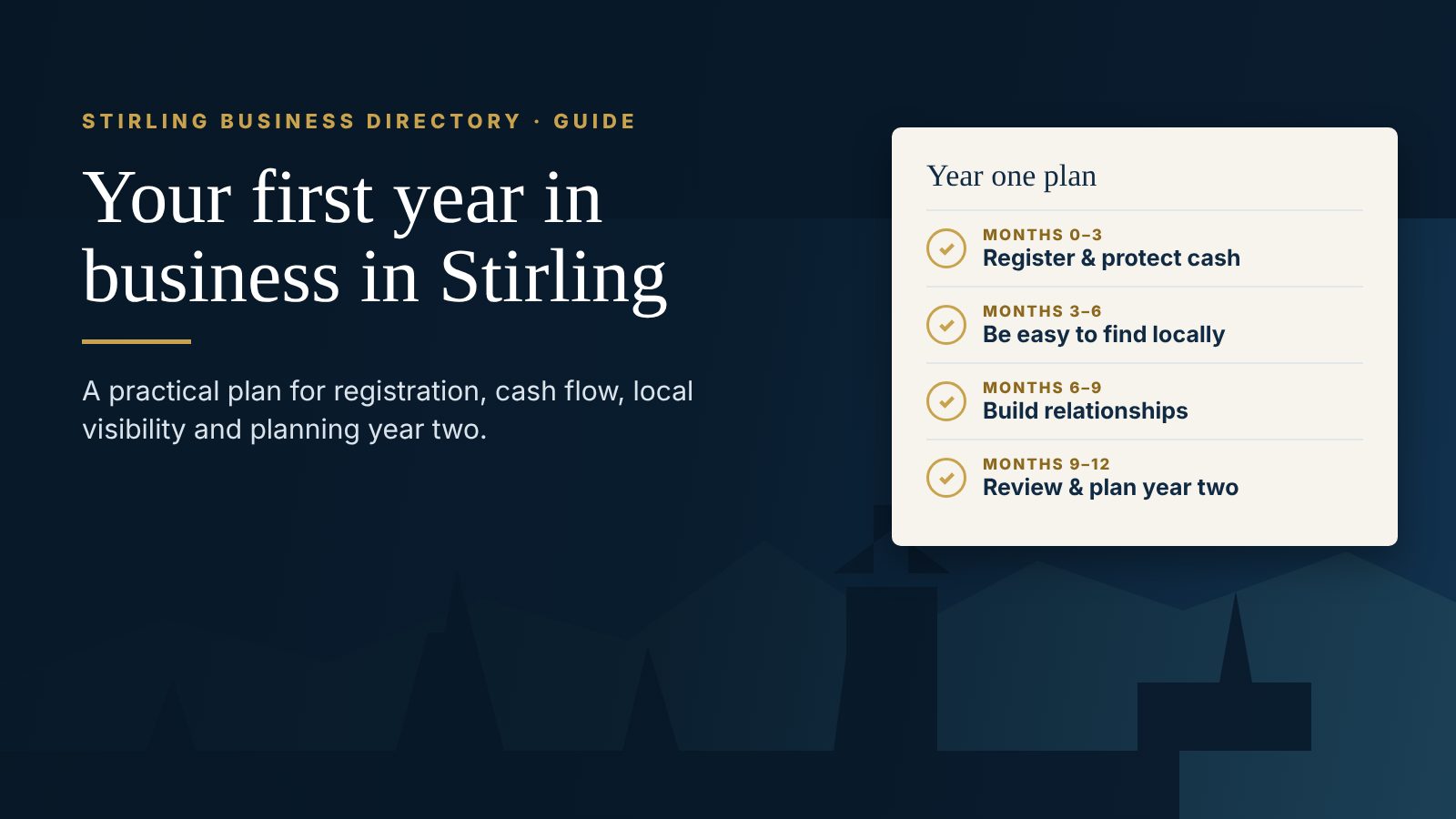
Opening a new business in Stirling is exciting, and the first twelve months tend to decide how the next few years feel. Most of the problems new owners run into are not about the product or the skill they are selling. They come from paperwork left too late, cash that was harder to predict than expected, or customers who simply did not know the business existed. This guide walks through a practical first-year plan for founders in Stirling and the wider Central Scotland area, whether you are a sole trader starting from a spare room or a small team taking on premises in the city centre.
Every business is different, so treat this as a checklist of questions to answer rather than a set of rules. Where something depends on your own circumstances, such as tax, insurance or licensing, check the details with the relevant official body or a qualified adviser.
Before you open: get the foundations right
Choose a structure and register it properly
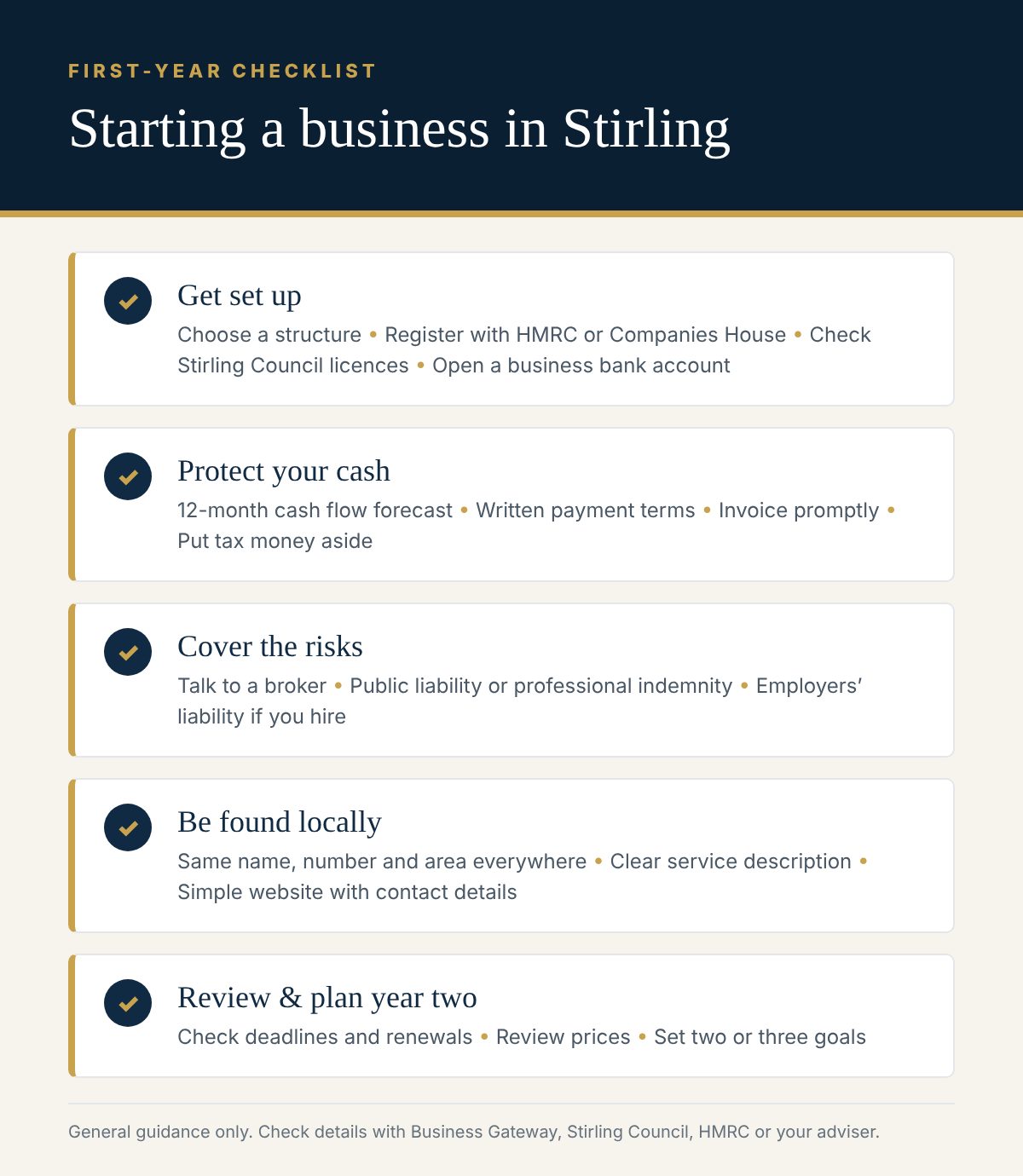
The first decision is usually whether to trade as a sole trader, a partnership or a limited company. Each has different implications for personal liability, tax and administration. Sole traders register for Self Assessment with HMRC; limited companies are incorporated through Companies House and then have their own filing and tax duties. If you are unsure which suits you, the free advisers at Business Gateway, Scotland’s publicly funded business support service, can talk you through the options before you commit.
Check whether you need a licence or permission
Some activities need a licence from Stirling Council before you trade. Selling food, running a taxi or private hire service, street trading, and selling alcohol are common examples, and businesses working from home may also need to consider planning rules or the terms of their lease or mortgage. It is much easier to ask the council early than to pause trading later while an application is processed.
Separate your money from day one
Open a dedicated business bank account, even if you are a sole trader and it is not strictly required. Keeping business income and spending apart makes bookkeeping simpler, gives you a clear picture of how the business is actually doing, and saves a great deal of time when your accountant prepares your year-end figures.
The first three months: protect your cash flow
Many new businesses are profitable on paper but still feel short of money, because the gap between doing the work and getting paid is longer than expected. A simple twelve-month cash flow forecast in a spreadsheet, updated every month, is one of the most useful tools a new owner can have. List the money you expect to come in, when it will realistically arrive, and every regular cost, including the ones that only appear once a year.
- Agree payment terms in writing before you start work, and put them on every quote and invoice.
- Invoice promptly, ideally the day a job is finished, and diarise a polite follow-up for anything that goes overdue.
- Set money aside for tax in a separate savings pot as you go, so a tax bill never arrives as a surprise.
- Keep receipts and records in one place from the start. Digital bookkeeping software or even a well-organised folder will save hours later.
Insurance belongs in this early stage too. Depending on your work, you may need public liability cover, professional indemnity cover, or employers’ liability insurance once you take on staff, which is a legal requirement in most cases. Speak to a broker about what your activities actually involve rather than buying the cheapest policy that looks roughly right.
Months three to six: make it easy for local customers to find you
Word of mouth matters enormously in Stirling, Bridge of Allan, Dunblane and the surrounding villages, but recommendations only work if people can check you out afterwards. When someone hears your name from a neighbour, they will usually look you up before getting in touch. The aim is to make sure that what they find is accurate, current and reassuring.
Start with the basics. Use exactly the same business name, address or service area, phone number and email everywhere you appear, from your invoices and van signage to your social media pages and directory entries. Write a short, plain description of what you do and where you work, and keep your opening hours up to date, especially around holidays. Adding your business to relevant local resources, such as the Stirling Business Directory submission form, gives residents another place to discover you.
At some point most businesses also want a website of their own, even a simple one. It does not need to be elaborate in the first year. A clear page explaining your services, the areas you cover, how to contact you and some examples of your work is often enough to turn a recommendation into an enquiry. Some owners build this themselves with an online website builder; others prefer to hand it over and concentrate on the work they are good at. If you go down the second route, ask any provider who will own the domain and the site, what ongoing costs to expect and how changes will be made. For founders who would rather talk it through locally, Crowstep Digital, a small web studio based just outside Stirling, is one of several options in the area, and it is worth comparing a few before you decide.
Months six to nine: build relationships, not just sales
Once the business is running, look for ways to become part of the local business community. Stirling has active networking groups, chamber and trade organisations, and regular events where owners share referrals and practical advice. Other businesses are often the best source of introductions, particularly where your services complement theirs. A joiner and a plasterer, or a bookkeeper and a small business lawyer, can send each other a steady stream of work.
Ask happy customers for honest feedback and, where they are willing, a review. Never write reviews yourself or offer incentives in exchange for positive ones; genuine feedback is far more persuasive and keeps you on the right side of consumer protection rules. When feedback is less positive, reply calmly and look at whether there is something you can improve.
Months nine to twelve: review, adjust and plan year two
Towards the end of the first year, set aside a few hours to look back honestly. Which services or products were most profitable once your time was counted? Which customers paid reliably, and which caused stress? Where did your enquiries come from? Even a rough answer to these questions will help you decide what to do more of and what to drop.
This is also the time to check deadlines for the year ahead, including your Self Assessment or company accounts, any VAT obligations if your turnover is approaching the registration threshold, and renewal dates for insurance and licences. Put them all in one calendar with reminders a month in advance.
- Update your cash flow forecast for the next twelve months.
- Review your prices against your costs and the time each job really takes.
- Check that your contact details and descriptions are still accurate everywhere you are listed.
- Set two or three realistic goals for year two, such as a new service, a first employee or a new area to cover.
Where to find support in Stirling
You do not have to work it all out alone. Business Gateway offers free start-up workshops and one-to-one advice across Scotland, Stirling Council can advise on licensing and local regulations, and HMRC and Companies House publish clear guidance on registration and filing. Your accountant, bank and insurance broker can also help you avoid common first-year mistakes. Browse the Stirling Business Directory to find local sector guides and businesses that may be able to help as you grow.
This guide was written for the Stirling Business Directory by the team at Crowstep Digital, who work with independent trades and service businesses across Central Scotland. It is general information rather than legal, tax or financial advice.
Run a business in this sector?
Submit your details for consideration in the Stirling Business Directory.
Submit Your Business